
How to Spot Prediction Market Arbitrage Opportunities Before They Disappear


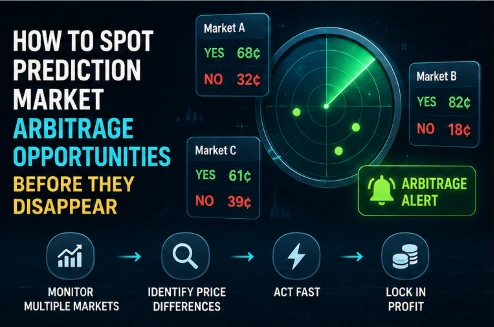
Cross-platform price gaps in prediction markets don't last long. Research on political and macroeconomic markets has found that cross-platform discrepancies typically persist for only 4 to 18 minutes before closing ‒ enough time for a systematic trader to act, but far too short for someone refreshing browser tabs by hand. Spotting prediction market arbitrage opportunities before they vanish comes down to watching the right signals, using tools built for the job, and moving fast once a real gap appears. Tracking platforms like Zephyr exist specifically to surface these cross-market gaps in one view, which is a meaningfully faster starting point than checking each exchange separately.
This guide covers where mispricings tend to show up, the tools traders use to catch them early, and a practical workflow for going from spotted gap to executed trade without losing the edge in between.
Where Mispricings Actually Come From
Arbitrage opportunities aren't random noise ‒ they trace back to a handful of recurring causes, and knowing them helps narrow down where to look first.
- Different user bases: crypto-native traders and traditional-finance participants price the same event using different information and different biases, so their platforms rarely land on identical numbers.
- Deposit and withdrawal friction: moving funds between platforms takes time, so a gap can persist simply because not every trader has capital ready on both sides.
- News lag: breaking news updates one platform's order book before another. FOMC statements, election calls, and live sporting events are the clearest examples ‒ one 2026 rate announcement saw one platform's market reprice within 30 seconds while a comparable market elsewhere took roughly three minutes to catch up.
- Thin liquidity: lower-volume markets update more slowly and are more prone to leftover mispricing than high-volume flagship markets.
Tools Traders Use to Catch Gaps Early
Manual monitoring doesn't scale once you're tracking more than a handful of markets. The prediction market industry processed tens of billions of dollars in trading volume last year, and price discrepancies between platforms now regularly appear and vanish within seconds ‒ which is why most active traders lean on some combination of the tool types below.
|
Tool Type |
What It Does |
Best For |
|---|---|---|
|
Odds aggregators |
Pull live prices for the same event across multiple platforms into one dashboard |
Spotting cross-platform gaps without tab-switching |
|
Alert / Telegram bots |
Push instant notifications when a spread crosses a set threshold |
Traders who can't watch screens all day |
|
Custom API dashboards |
Query exchange APIs directly (e.g., Polymarket CLOB, Kalshi) every few seconds |
Traders comfortable with code who want full control |
|
AI-driven analytics |
Score markets for mispricing likelihood using on-chain and sentiment data |
Filtering noise before manual review |
|
Execution bots |
Auto-place both legs of a trade once a spread threshold is met |
High-frequency, latency-sensitive arbitrage |
A Practical Spotting Workflow
Whether you're doing this manually or with software, the underlying steps are the same:
- 1. Identify overlapping markets ‒ confirm the same real-world event is listed on two or more platforms with genuinely equivalent resolution criteria.
- 2. Pull live prices side by side ‒ an aggregator or dashboard that shows both platforms at once beats switching between browser tabs.
- 3. Calculate the combined cost ‒ add the cost of both legs (YES on one side, NO on the other, or YES+NO on a single platform) and compare it to the guaranteed $1.00 payout.
- 4. Subtract fees and expected slippage ‒ a spread has to clear your total cost stack, not just look good at face value.
- 5. Check executable depth ‒ confirm there's enough volume at the quoted price to fill your intended size without moving the market against you.
- 6. Execute both legs as close to simultaneously as possible ‒ the gap between placing leg one and leg two is where most of the risk lives.
Signals Worth Watching For
- Markets tied to imminent, high-certainty catalysts ‒ Fed meetings, major economic releases, and election calls create the sharpest, fastest-moving gaps.
- Whale or large-wallet activity ‒ sudden large trades on one platform often precede a repricing that hasn't yet reached a competing platform.
- Newly listed markets ‒ a market that just launched on one platform but has an established equivalent elsewhere is a common source of temporary mispricing.
- Combined YES/NO pricing drifting away from $1.00 on a single platform ‒ the simplest and most beginner-friendly signal to track, since it requires no cross-platform comparison at all.
Why Speed Alone Isn't Enough
A study on low-volume markets found that 78% of spotted arbitrage opportunities failed at the execution stage, not the spotting stage ‒ meaning traders correctly identified a gap but couldn't capture it before the price moved. That statistic is a useful reality check: finding a spread is only half the job. Confirming resolution criteria actually match, checking real order-book depth rather than the top quote, and having capital already positioned on both platforms all matter as much as reaction speed.
Frequently Asked Questions
How long do prediction market arbitrage opportunities typically last?
Research on political and macroeconomic markets found cross-platform gaps commonly close within 4 to 18 minutes, though windows tied to breaking news can be far shorter ‒ sometimes closer to seconds once high-frequency traders spot them.
Do I need to code to spot arbitrage opportunities?
Not necessarily. Odds aggregators and alert-based tools can surface gaps without any programming, though building a custom monitoring dashboard or execution bot generally requires comfort with an exchange's API.
What's the fastest way to catch a temporal arbitrage window around breaking news?
Monitoring both platforms simultaneously through a shared dashboard, rather than checking one at a time, is the most reliable manual approach; automated alert systems or execution bots close the gap further for traders who want to compete with faster market participants.
Are all price gaps real arbitrage opportunities?
No. A gap only counts as arbitrage once it clears total transaction costs (fees, slippage, gas) and the two markets genuinely share identical resolution criteria. A gap that looks attractive on the surface can turn into a directional bet if either of those checks fails.
Is automated monitoring worth it for a beginner?
Alert tools that simply notify you of a gap, without executing trades automatically, are a reasonable middle ground for beginners ‒ they remove the need to watch screens constantly while still leaving the decision to trade in your hands.
Final Thoughts
Spotting prediction market arbitrage before it disappears is less about any single trick and more about consistent process: knowing where mispricings tend to originate, watching the right markets, and using tools that surface gaps faster than manual checking ever could. Even then, speed only pays off when it's paired with discipline ‒ verifying resolution rules and real liquidity before acting is what separates a captured spread from a missed one.
Check out other news and articles on Google News
Disclaimer:
The articles published on hoka.news are intended to provide up-to-date information on various topics, including cryptocurrency and technology news. The content on our site is not intended as an invitation to buy, sell, or invest in any assets. We encourage readers to conduct their own research and evaluation before making any investment or financial decisions.
hoka.news is not responsible for any losses or damages that may arise from the use of information provided on this site. Investment decisions should be based on thorough research and advice from qualified financial advisors. Information on hoka.news may change without notice, and we do not guarantee the accuracy or completeness of the content published.